Bolting Services
Hydraulic bolting services play a major role in oil rigs and refinery maintenance because they ensure safe, precise, and efficient tightening of critical bolted joints. Below is a detailed breakdown of their benefits:
1. Safety Enhancement
Reduced Human Injury Risk: Eliminates manual hammering/torquing, preventing hand injuries, slips, and falls.
Leak Prevention: Ensures precise bolt tensioning to avoid catastrophic leaks (hydrocarbons, toxic chemicals).
Explosion Mitigation: Properly sealed flanges prevent ignition sources in volatile atmospheres.
2. Operational Efficiency
Speed: Hydraulic tools tighten/loosen multiple bolts simultaneously, reducing downtime (e.g., turnaround times cut by 30-50%).
Accessibility: Compact tools reach confined spaces (pump seals, reactor internals) unreachable by manual methods.
24/7 Readiness: Weather-resistant equipment operates in extreme conditions (offshore storms, desert heat).
3. Precision & Consistency
Exact Torque/Tension Control: Computerized systems achieve ±3% accuracy vs. ±25% with manual methods.
Uniform Load Distribution: Prevents warping/flange damage via simultaneous multi-bolt tensioning.
Compliance: Meets ASME PCC-1, ISO 9001, and API standards for critical joints.
4. Equipment Longevity
Reduced Bolt Fatigue: Avoids over/under-torquing, extending bolt lifespan.
Corrosion Management: Specialized coatings/lubricants prevent galling in sour gas/H₂S environments.
Flange Protection: Eliminates uneven loading that causes micro-movements and wear.
5. Cost Savings
Labor Reduction: 1 hydraulic technician replaces 4-5 manual laborers.
Downtime Minimization: Faster maintenance = $100K+/hour savings in production loss (e.g., FCC unit shutdowns).
Avoiding Failures: Prevents unplanned shutdowns from leaks (e.g., $1M+/day in offshore rigs).
6. Documentation & Traceability
Digital Records: Automated logs of torque/tension values for audits and failure analysis.
Bolt Load Verification: Ultrasonic measurement integration ensures post-tensioning integrity.
Critical Applications:
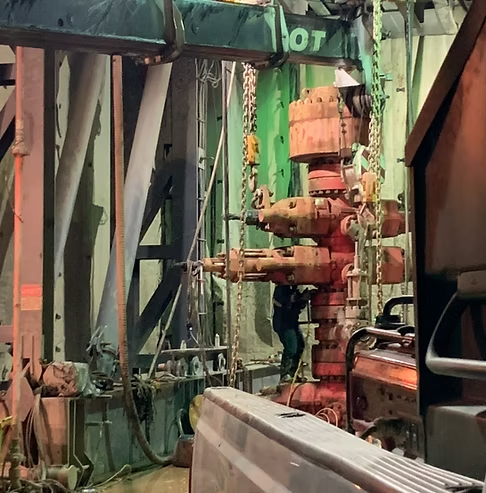
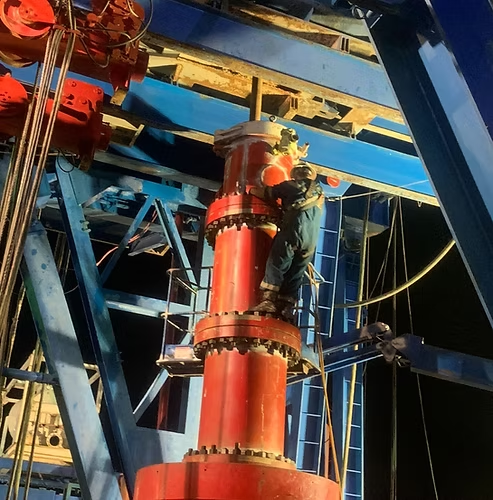
Oil Rigs: Wellhead trees, Christmas valves, BOP stacks.
Refineries: Reactor flanges, heat exchangers, distillation column manways.
Pipelines: Compressor stations, pig launchers, emergency shutdown valves.
Industry Data:
Studies show hydraulic bolting reduces flange leak rates by 70% versus manual methods (EPRI).
Refineries report 40% faster maintenance turnarounds using hydraulic systems (Shell Canada case study).